
19th Oct 2026
Air-Release Adhesive Technology Explained: Why It Matters for a Clean Install
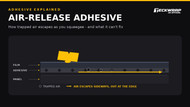
Bubbles are trapped air, and air release vinyl gives that air a way out. Fine channels in the adhesive let air escape sideways while you squeegee. That reduces bubbles and speeds up lay-down on most panels. It won't fix poor prep, rushed technique, or skipped post-heating. This guide separates air-release from repositionable and shows how to compare adhesives fairly.
Air-Release Adhesive at a Glance
This table compares the air release adhesive vinyl wrap systems installers ask about most. Where a datasheet is silent, the table says so instead of guessing.
|
Factor |
Avery Dennison (Easy Apply RS) |
HEXIS (HEX'Press) |
TeckWrap |
|
Technology name |
Easy Apply RS |
HEX'Press |
No branded name |
|
Air-release |
Yes, air egress channels |
Yes, structured adhesive for air egress |
Yes, air-release channels listed |
|
Repositionable |
Yes, low initial tack allows repositioning |
Yes, film can slide before final pressure |
Check datasheet for the specific finish |
|
Adhesive base |
Permanent acrylic, long-term removable, per Avery Dennison datasheet |
Clear permanent solvent-based acrylic, per HEXIS datasheet |
Henkel solvent-based acrylic, per TeckWrap datasheets |
What Air-Release Adhesive Actually Is
Air-release adhesive has fine channels across the glue side of the film. Some brands use a structured adhesive surface instead of visible channels. As you squeegee, trapped air travels along those paths and leaves at the edge.
This is why air release vinyl lays down faster than film without channels. You spend less time chasing bubbles with a pin or a heat gun. On large panels like bonnets and van sides, that saving matters most.
Air egress vinyl is another name for the same escape-route idea. Avery Dennison and HEXIS both use the term air egress in their product material. Air still needs a route to an open edge, so your squeegee strokes matter.
Datasheets use several different names for the same feature. Look for air-release, air egress, or structured adhesive in the description. If the datasheet says nothing, ask your supplier in writing.
Air-Release vs Repositionable: Not the Same Thing
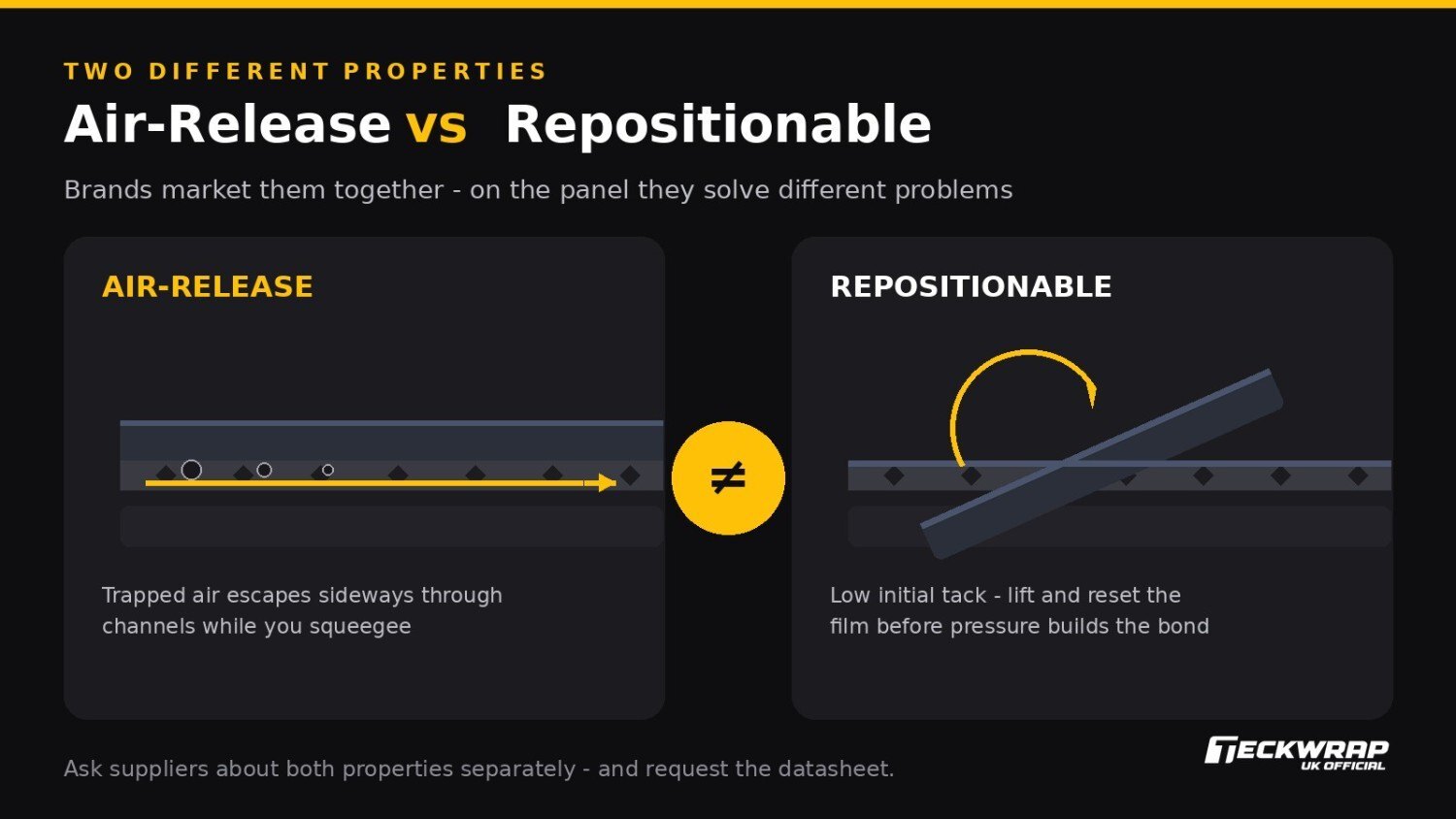
Air-release and repositionable describe two different properties of the same adhesive. Brands often market them together, so many installers treat them as one feature. On the bay floor, they solve two separate problems.
- Air-release: fine channels let trapped air escape while you squeegee the film down.
- Repositionable: lower initial tack lets you lift and reset the film before pressure builds the bond.
A repositionable vinyl wrap adhesive helps you align the film before it bonds. Air-release helps you remove air after the film touches the panel. A film can have channels without being easy to slide into position. A film can also slide freely and still trap air in the middle.
Repositioning helps most when alignment matters, such as long graphics and panel edges. Air-release helps most when trapped air has a long way to travel.
Avery Dennison markets Easy Apply RS as repositionable during application. HEXIS describes HEX'Press as repositionable, so the film can slide before final pressure. Ask a supplier about both properties separately, and ask for the datasheet.
What It Changes on the Job and What It Doesn't
Air-release adhesive changes three things you feel on the job. Each one affects how long a panel takes and whether it comes back.
- Lay-down speed: air leaves as you work, so you spend less time chasing it.
- Bubble risk: fewer pockets of air stay trapped under the squeegee.
- Comeback risk on large panels: fewer trapped air pockets leave fewer reasons to revisit.
It does not change what happens before or after the squeegee. These four problems stay yours to prevent, whatever adhesive you buy.
- Poor surface prep: dirt and oils still stop the adhesive from bonding.
- Contamination: dust under the film still shows as a lump.
- Overstretching: stretched film still pulls back at the edges.
- Skipped post-heating: heat still sets the film into curves and recesses.
Bay time and comebacks are where adhesive choice shows up in your costs. A film that lays down cleanly wastes fewer paid hours on bubble chasing.
Post-heating sets stretched film into curves and removes built-in tension. Read why post-heating is crucial for the full method. For bubbles that appear after install, see how to remove air bubbles. TeckWrap's guides on avoiding bubbles and installing like a pro cover the how-to side. The vinyl wrap installation guide covers tools and troubleshooting.
Branded vs Unbranded: How to Compare Adhesives Fairly
A brand name tells you what to call the system, not its performance. Avery Dennison calls its system Easy Apply RS, and HEXIS calls its own HEX'Press. Neither name proves how the adhesive performs on your own panel. Treat any bubble-free claim as a design goal, not a guarantee on your panel.
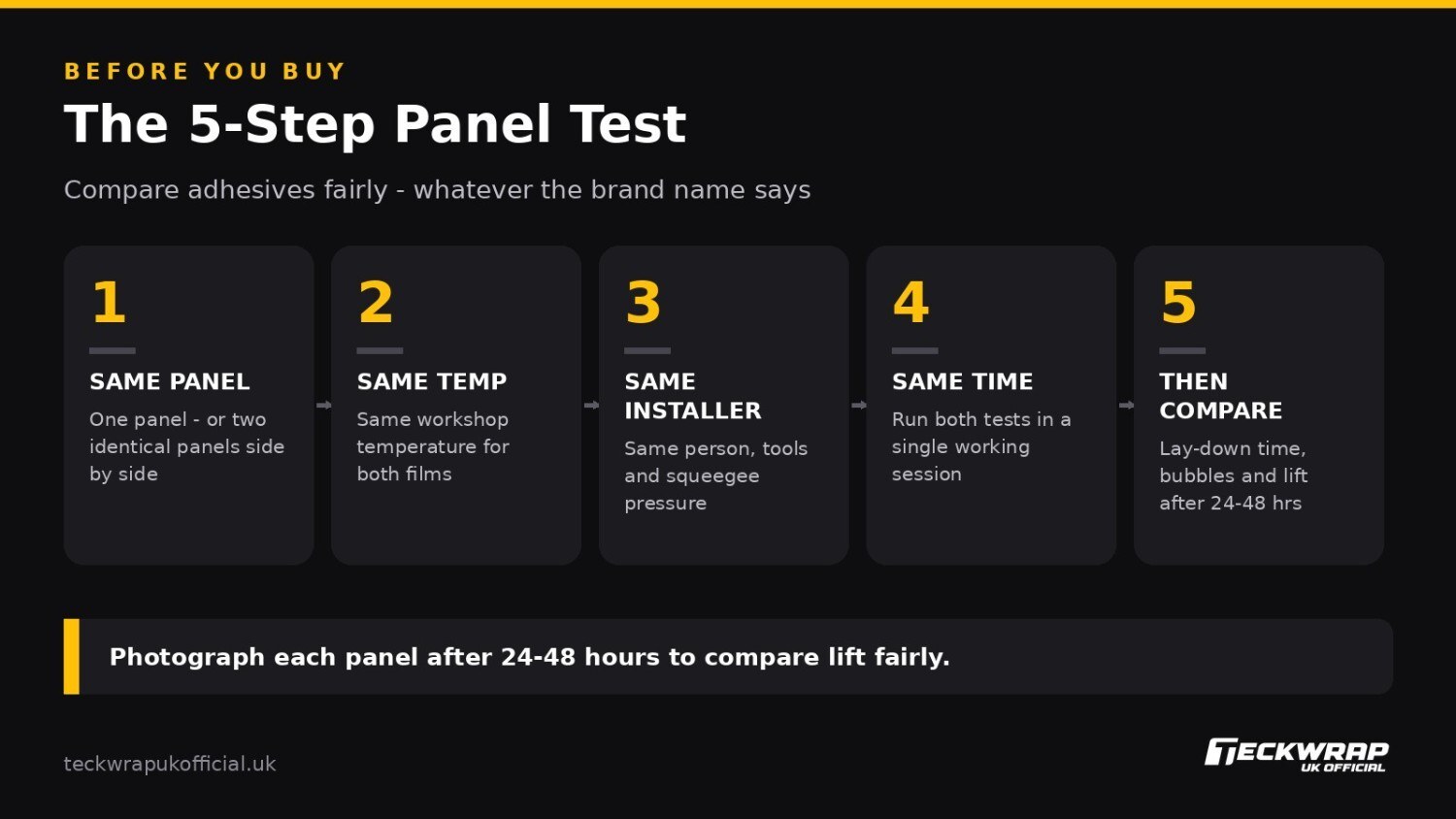
A simple panel test gives you a fair answer. This guide quotes no test results, because every panel and installer differs.
- Same panel: use one panel, or two identical panels side by side.
- Same temperature: keep the workshop temperature the same for both films.
- Same installer: use the same person, tools, and squeegee pressure.
- Same time: run both tests in one session so conditions match.
- Then compare: note lay-down time, bubble count, and any lift after 24 to 48 hours.
Check each film's datasheet for its recommended application temperature before you start. Photograph each panel after 24 to 48 hours to compare lift fairly.
What TeckWrap Uses
Per TeckWrap's datasheets, its films list air-release channels as a feature. The adhesive is a Henkel solvent-based acrylic, described as ultra-weather-resistant. TeckWrap does not brand this technology with a name of its own.
Henkel is the adhesive supplier named on the datasheets. The datasheets checked do not state whether each film is repositionable. Check the datasheet for the specific finish before you assume it slides.
The best proof is a sample on your own panel. An A4 sample gives you a small flat area to test squeegee behaviour. Order sample swatches and run the panel test against your current film. Compare lay-down, bubbles, and lift the same way you would for any supplier.
For wider supplier comparisons, read TeckWrap vs Avery Dennison and TeckWrap vs HEXIS SKINTAC. Both pieces compare adhesive alongside construction, colour range, and supply. For how film construction affects installs, see cast vs calendared vinyl.
Air-Release Adhesive FAQs
What is air-release adhesive on vinyl wrap?
Air-release adhesive is a glue layer with fine channels that let trapped air escape. You squeegee the film down and the air leaves sideways along those channels. This reduces bubbles and speeds up lay-down on most panels. Brands use different names, but the basic function stays the same.
Is air-release the same as repositionable?
No, air-release and repositionable are two separate properties of the adhesive. Air-release lets trapped air escape while you squeegee the film. Repositionable means lower initial tack, so you can lift and reset the film. Brands often market both together, so ask about each one separately.
Can air-release film still bubble?
Yes, air-release film can still bubble if the install goes wrong. Dirt on the panel, sealed air pockets, and rushed squeegee strokes all create bubbles. No adhesive works as a bubble free vinyl wrap adhesive without good technique. Clean prep and a steady squeegee still matter on every panel.
Does air-release adhesive replace post-heating?
No, air-release adhesive does not replace the post-heating step. Channels help air escape during application, but heat sets the film afterwards. Post-heating locks stretched film into curves, edges, and recesses. Skipping it can cause lifting later, even when the install looks clean.
Is a branded air-release adhesive better than an unbranded one?
No, a brand name does not prove better performance. Easy Apply RS and HEX'Press name the system, not how it behaves. Compare films on the same panel at the same temperature with the same installer. Real panel results tell you more than any trademark can.
Get TeckWrap Trade Pricing
Ready to compare real pricing on the films you shortlist? See TeckWrap trade pricing through your own trade account. Read how to open a TeckWrap trade account before you apply. For a low-commitment start, order sample swatches and test the adhesive yourself.