

9th Nov 2026
TeckWrap Film Warranty Explained: What UK Trade Buyers Need to Know
A customer asks how long the wrap is guaranteed, and a vague answer costs you trust. TeckWrap's warranty is set out in a technical datasheet, and it depends on two things: where the film is used (climate zone) and how the panel faces the sun (exposure angle). This guide explains what the datasheet says for UK installers, what it does not cover, and how to talk to customers about it.
TeckWrap Warranty at a Glance
|
What it says |
Detail |
Source |
|
UK climate zone |
The United Kingdom is listed in Zone 1 |
Datasheet, Durability Information |
|
Vertical panels (within ±10° of vertical) |
3 years in Zone 1 |
Datasheet |
|
Non-vertical and horizontal panels (10°–90° from vertical) |
2 years in Zone 1 |
Datasheet |
|
General expected performance life |
Up to 5 years, mainly depending on exposure angle and climate |
Datasheet |
|
Scratches during application or regular use |
Not covered by the warranty |
Product pages, e.g. Blue Gem |
|
Slight, gradual change in colour and gloss |
Unavoidable, treated as normal wear and tear |
Datasheet |
The figures come from TeckWrap's technical datasheet for its high-performance hybrid calendared self-adhesive films, which the Durability/Warranty line on each product page links to (checked 5 November 2026).
What the Warranty Covers
The datasheet gives a warranty period for each climate zone and exposure angle. It describes those periods as an estimate of how long the film visually retains its expected colour pigment and surface finish. It does not itemise individual defects or describe how a claim is made. If a problem develops, contact the UK team on 033 33 231559 or at sales@teckwrapukofficial.co.uk.
Keep the manufacturer's film warranty separate from your own workmanship guarantee. Your workshop controls cleaning, fitting, trimming and finishing, so install-related problems belong in your own customer terms.
What It Does Not Cover
- Scratches during application or regular use are not covered, per the product pages.
- Normal wear: the datasheet says a slight, gradual change in pigment colour and gloss is unavoidable and counts as normal wear and tear.
- Factors that can reduce durability: the datasheet lists the quality and preparation of the surface, surface texture, film maintenance and cleaning, and the degree of pollution.
Aftercare matters too. The Blue Gem page recommends pH-neutral products and avoiding hot wax or solvents. For customer handover, share our aftercare guide and maintenance guide.
How Climate Zone and Panel Angle Change the Term
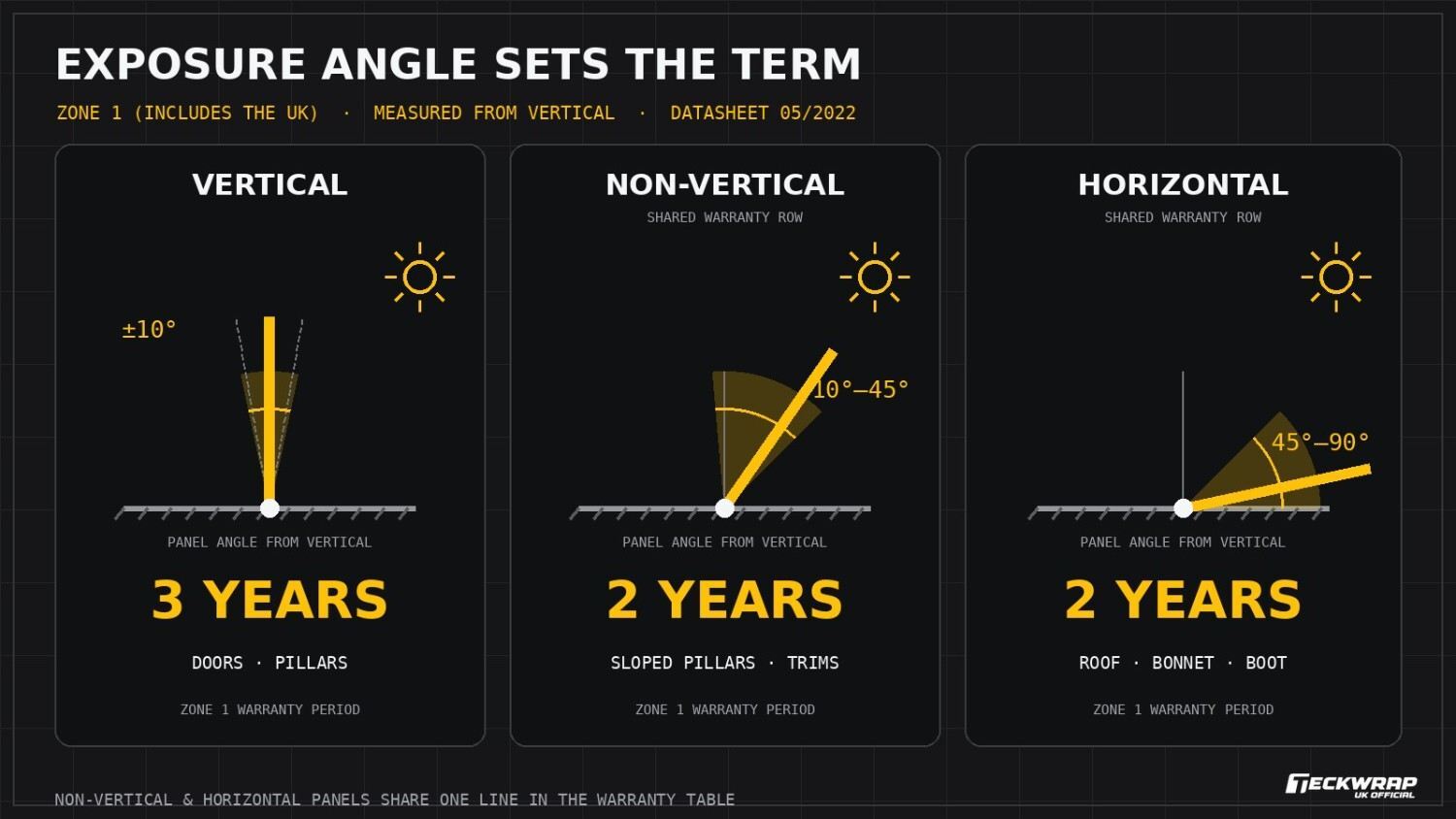
Roofs and bonnets take more direct sun and weather than upright doors, so their period is shorter. The datasheet defines three exposure angles: vertical (within ±10° of vertical), non-vertical (10°–45° from vertical), and horizontal (45°–90° from vertical). Non-vertical and horizontal panels share one line in the warranty table.
|
Warranty period |
Zone 1 (includes the UK) |
Zone 2 |
Zone 3 |
|
Vertical exposure |
3 years |
2 years |
Up to 1 year |
|
Horizontal and non-vertical exposure |
2 years |
1 year |
Up to 1 year |
On a typical car, the doors sit in the vertical band while the roof and bonnet fall in the horizontal one. Record which panels are which before you quote, so the customer hears the right period for each.
Some product pages also give their own figures. The Cherry Red Chrome page, for example, states 4 years indoor life and 2 years outdoor life. When a page gives its own figure, quote that figure for that film. Older reference pages such as the 180 series and 190 series pages may show different numbers, so use the datasheet linked on the film's product page.
Removal During the Warranty Period
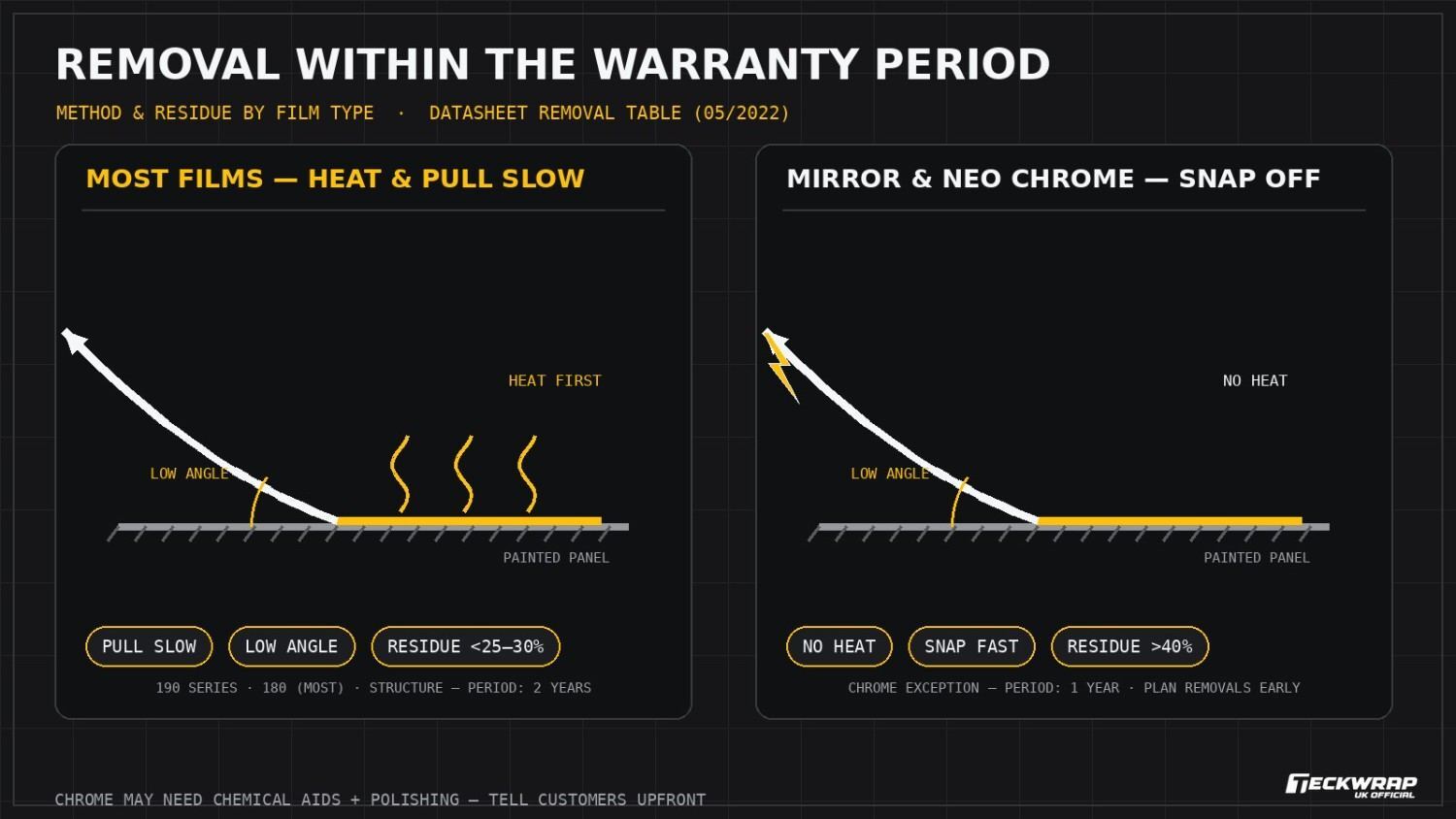
The datasheet also sets out how each film type should come off. When removing film within the warranty period, heat the surface first and pull the film at a low angle and slow speed. Chrome is the exception: do not heat chrome film during removal, and pull it off quickly or "snap" it off at a low angle to limit adhesive residue.
|
Series |
Product type |
Method |
Residue |
Period |
|
190 |
Gloss and colour-shift metallic |
Heating |
Less than 25% |
2 years |
|
190 |
Chameleon and glitter metallic |
Heating |
Less than 30% |
2 years |
|
190 |
Satin and matte metallic |
Heating |
Less than 30% |
2 years |
|
180 |
Gloss aluminum |
Heating |
Less than 30% |
2 years |
|
180 |
Satin chrome |
Heating |
Less than 30% |
2 years |
|
180 |
Mirror and neo chrome |
No heat |
More than 40% |
1 year |
|
180 |
High gloss |
No heat |
Less than 25% |
2 years |
|
180 |
Matte and super matte |
No heat |
Less than 25% |
2 years |
|
180/190 |
Structure |
Heating |
Less than 30% |
2 years |
Mirror and neo chrome films can be removed with chemical aids and polishing and may leave more than 40% adhesive residue, so plan chrome removals and tell customers early.
Where to Find the Datasheet for Your Film
- Open the film's product page, for example, Blue Gem.
- Find the Durability/Warranty line in the specifications.
- Click the Datasheet link to open the PDF.
- Keep a copy with your quotation and customer records.
The Install Guide also holds the series information pages and recommendations for each finish.
What to Tell Your Customers
Give the exact film name and a simple explanation, ideally in writing at handover:
"Your film comes with manufacturer warranty terms that depend on climate zone and how each panel faces the sun. For the UK, vertical panels such as doors carry a longer period than the roof and bonnet. Scratches during fitting or everyday use are not covered, and gradual colour or gloss change is treated as normal wear. Our installation workmanship is covered separately, in writing."
Give care instructions at handover rather than weeks later. For wider lifespan context, point customers to How Long Does A Car Wrap Last? and car wrap durability: fact vs fiction. Do not turn an expected lifespan into a contractual guarantee.
Records Worth Keeping on Every Job
These are good workshop practices rather than confirmed claim requirements:
- Installation date, film code and lot numbers
- Which panels were wrapped, and their exposure angle
- The datasheet and care advice you supplied
- Photographs of each finished panel
- Any customer concerns noted before the vehicle left
Warranty FAQs
Does TeckWrap film come with a warranty?
Yes. TeckWrap's datasheet gives warranty periods by climate zone and exposure angle, and the Durability/Warranty line on each product page links to it. The datasheet does not describe the claims process, so contact the UK team if a problem develops.
Is the warranty the same for roofs and bonnets as for doors?
No. In Zone 1, which includes the UK, vertical panels carry 3 years and non-vertical or horizontal panels such as roofs and bonnets carry 2 years. Record the exposure angle of each panel before quoting.
Are scratches covered by the TeckWrap warranty?
No. Product pages state that scratching during application or regular use is not covered. The datasheet also treats gradual colour and gloss change as normal wear. Explain this before fitting, and keep your workmanship terms separate.
Where do I find the warranty for a specific film?
Open the product page and find Durability/Warranty, then click the Datasheet link. If the page states its own indoor or outdoor life figure, quote that figure for that film.
How long does a TeckWrap wrap last?
The datasheet gives expected performance life as up to 5 years, mainly depending on exposure angle and climate, with surface preparation, maintenance and pollution also playing a part. That is separate from the warranty period. Read our guide on how long a car wrap lasts for more.
Get TeckWrap Trade Pricing
Check each film's datasheet before you finalise what you promise customers. Our guide on how to open a trade account explains purchasing and ordering, and the trade login shows the pricing available to your account.
See TeckWrap Trade Pricing → | Ask About a Specific Film Warranty →